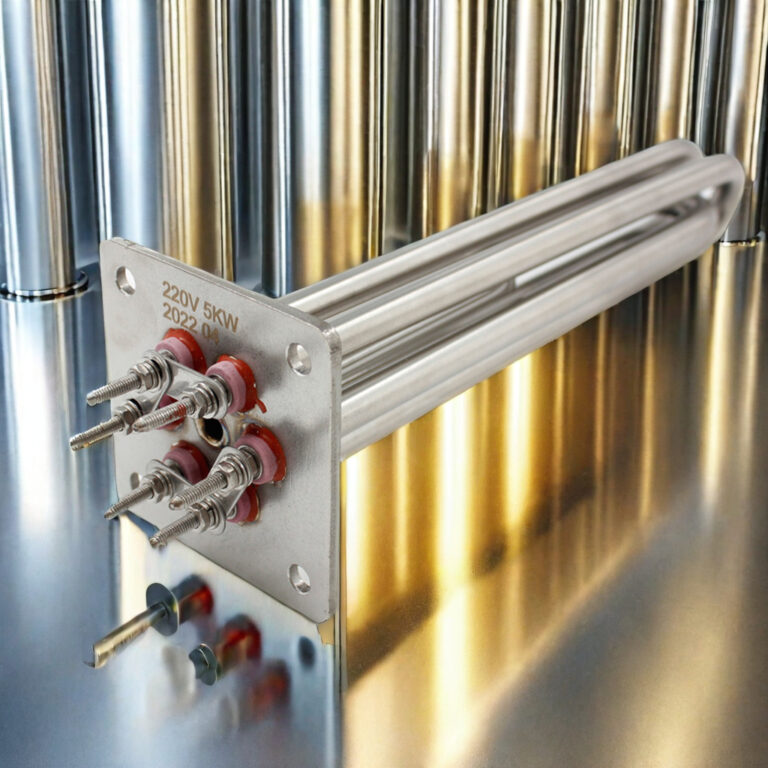
如果工业加热器的额定值为 6 KW, that number alone does not tell you whether the design will last. The same power can be spread over a long tubular element or concentrated on a short surface, producing very different sheath temperatures and failure risks. 这 watt density calculation guide shows how to calculate surface load, reverse-check a supplier quote, and identify when the result is unsafe for the actual application.
Contents

What Does Watt Density Tell an Engineer?
Watt density is the electrical power applied to a defined active heating area. It is usually expressed as W/cm² or W/in². The value links the electrical design to heat transfer: when the same power is concentrated on less surface, the element must release more heat from each unit of area.
A calculation is useful only when the area is defined correctly. For a straight tubular element, use the heated length and outside circumference, not the total length including cold ends, terminals, or unheated support sections. For a formed element, ask the manufacturer which sections are electrically active.
How Do You Perform a Watt Density Calculation?
The basic formula is: watt density = total element power ÷ active surface area. For a round tube, active surface area is approximately π × outside diameter × heated length. Keep the units consistent before dividing, because a diameter in millimeters and an area in square centimeters cannot be mixed in the same step.
Example: a 2,000 W element has a 10 mm outside diameter and 1,200 mm heated length. Its approximate surface area is 3.1416 × 1 cm × 120 cm = 376.99 cm². The calculated surface load is 2,000 ÷ 376.99 = 5.31 W/cm².
This result is a design input, not a universal pass or fail number. The acceptable range depends on whether the element heats moving air, 水, 油, a chemical bath, or a solid metal block. The same calculated value can behave differently when circulation, deposits, or contact resistance changes.
How Do You Convert Between W/cm² and W/in²?
One square inch contains 6.4516 square centimeters. Therefore, to convert W/cm² to W/in², multiply by 6.4516. To convert W/in² to W/cm², divide by 6.4516. Write the conversion beside the supplier’s stated unit so a decimal-place error does not pass unnoticed during quotation review.
For the example above, 5.31 W/cm² is approximately 34.26 宽/英寸². If a quote shows “5.31 W/in²” for the same geometry, the electrical load is not equivalent. The unit difference changes the engineering meaning by a factor of 6.4516.

How Can You Reverse-Calculate Required Heating Length?
When a target surface load has already been selected, reverse the formula to estimate the required active area: active area = total power ÷ target watt density. This gives the engineering team a first estimate of tube length, 直径, or the number of parallel elements needed for the assembly.
例如, a 3,000 W heater with a target of 4 W/cm² needs about 750 cm² of active area. A supplier can reach that area by changing tube diameter, heated length, or the number of circuits. The choice must then be checked against the available tank, duct, mold, or oven space.
Do not use the reverse calculation to select a final heater without checking controls and heat loss. Warm-up time, 绝缘, ambient losses, liquid movement, and allowable surface temperature can change the required power. A good RFQ includes the process duty and the geometry, not just a target watt density.
Why Can the Same Watt Density Behave Differently?
Moving water normally removes heat from a sheath more effectively than stagnant liquid. Air has different heat-transfer behavior again, while oil and chemical baths may create deposits or impose material limits. This is why a watt density calculation must always be paired with the operating medium and circulation condition.
Surface contamination also changes the result in service. Scale, carbon, or chemical deposits act as an insulating layer, forcing the sheath to run hotter even when the electrical input has not changed. 在我们的生产实践中, we connect surface load discussions with material selection, cleaning access, and maintenance intervals.
Vanorm has more than 40 years of heating-element experience, an 8,000 m² workshop, 和 200+ experienced staff according to our company profile. Our tubular, 浸没, cartridge, finned, and coated elements are custom-engineered for OEM applications rather than selected from power alone.
What Should You Check in a Supplier’s Calculation?
| Check | Ask the supplier to show | Why it matters |
|---|---|---|
| Active area | Heated length, outside diameter, and cold-end exclusion | Prevents an inflated area and artificially low watt density |
| 力量 | 电压, 阶段, 反抗, circuit grouping, and tolerance | Confirms the stated wattage matches the electrical design |
| 应用 | 中等的, circulation, operating temperature, and deposits | Links the calculation to real heat-transfer conditions |
| Protection | Sensor position, airflow/liquid interlock, and control stages | Reduces overheating during abnormal operation |
For safety and conformity questions, consult UL Solutions and request the certification scope for the exact heater assembly. UL or CE marking does not replace a process-specific thermal review, but it helps establish the documentation expected from a responsible supplier.
For related selection context, review our industrial heating element manufacturer guide, 这 heating element lifespan guide, and our custom OEM heating element process. These references help connect a watt density calculation with supplier capability, service life, and customization requirements.
供应商审核清单: 5 Documents to Request Before Signing a Purchase Order
- Watt density worksheet: Confirm power, active area, tube geometry, units, and the formula used.
- Thermal duty calculation: Check heat loss, warm-up target, operating medium, circulation, and design margin.
- Dimensional drawing: Verify heated length, cold ends, terminals, bends, mounting, and available clearance.
- Electrical schematic: Confirm voltage, 阶段, resistance tolerance, circuit stages, sensors, and interlocks.
- Inspection report sample: Request resistance, 绝缘, visual, labeling, and pre-shipment checks for the proposed assembly.
If a quotation gives only total watts and voltage, ask for the missing active-area calculation before comparing prices. The watt density calculation can reveal whether a shorter heated surface is creating a higher thermal load. That hidden difference moves the cost into premature failure, downtime, or more frequent maintenance.
常见问题解答
问: What is the basic watt density calculation formula?
Divide total heater power by the active heating surface area. For a round tube, estimate area from π × outside diameter × heated length, excluding cold ends and unheated sections.
问: Is a lower watt density always better?
不. A lower value can reduce surface temperature, but it may require more material, space, or circuits. The correct target must balance heat-transfer conditions, installation space, 响应时间, and service life.
问: What information is needed to calculate watt density accurately?
Provide power, 电压, active length, outside diameter, cold-end length, heating medium, circulation, operating temperature, and any deposit or corrosion risk. A supplier should state each assumption used in the worksheet.
问: Can I compare two heater quotes using wattage only?
不. Compare active area, watt density, 材料, control method, installation geometry, and inspection documents. Two heaters with the same total watts can have very different surface temperatures and maintenance requirements.
For a watt density calculation review, send our team your heater power, active dimensions, operating medium, circulation, and temperature target. We will check the geometry and application assumptions before recommending a custom element.