A three phase immersion heater wiring error seldom announces itself with a flash. It usually appears as a tank that never reaches setpoint, a breaker that trips after twenty minutes, or a terminal box reading low insulation resistance at commissioning.
Three phase immersion heater wiring follows the element nameplate, not whatever voltage the plant happens to supply. The rating fixes the connection, and the connection fixes current, protection and the sheath temperature the element actually sees.
This guide covers what changes between star and delta, why a mismatch is not a harmless derate, and which checks we insist on before a customer energizes a new assembly. Each check exists because we have watched a plant skip it and pay for the lesson twice.
What Does Three Phase Immersion Heater Wiring Actually Decide?
A three-phase assembly is a group of single-phase resistors arranged in one of two patterns. Star places each element between a line and a shared neutral point, while delta places each element across two lines.
The pattern decides the voltage across each sheath, and resistive power tracks the square of that voltage. A 10% voltage error becomes a 21% power error, so the pattern has to follow the element rating.
In our production practice the connection is printed on the nameplate and repeated on the terminal cover. Lo mismo 9 kW assembly ships as a 480 V delta unit or a 277 V star unit depending on the order.
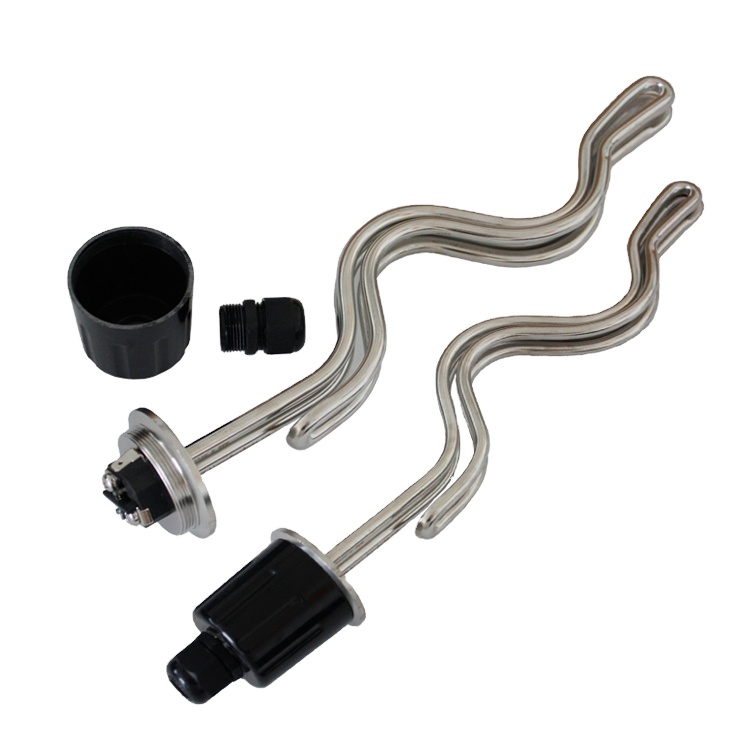
Why the Nameplate, Not the Supply, Sets Star or Delta
On a 480 Y/277 V system both connections are physically available, and only one of them is right for a given element. Delta applies the full 480 V line-to-line across each sheath, while star applies 277 V line-to-neutral.
Running a 480 V element in star will not destroy it immediately. It quietly delivers about a third of the rated heat, and the controller then holds the contactor closed far longer than the element was designed for.
The reverse case is worse. A 277 V element wired in delta sees 1.73 times its rated voltage, which pushes densidad de vatios past the sheath design limit and shortens service life sharply.
How Does Star or Delta Change the Voltage, Current and Power?
| Artículo | Star | Delta | What to verify |
|---|---|---|---|
| Voltage per element | Line voltage divided by 1.73 | Full line voltage | Element rating matches the pattern |
| Line current | Equal to element current | 1.73 times element current | Conductor and terminal size |
| Power at matched rating | Nameplate figure | Nameplate figure | kW printed at that voltage |
| One element open | Output drops by about one third | Output drops to about one sixth | Per-phase current monitoring |
The neutral conductor is the practical difference most installers notice first. Star needs a neutral terminal able to carry the full element current, and delta needs no neutral at all. Bring that neutral to a block rated for the current, not to a control terminal borrowed from the panel.
Delta also survives a lost line differently. With one phase missing the assembly becomes a single-phase load spread across two pairs, so the tank heats slowly and the current balance looks wrong on a clamp meter.
How Much Power Does a Mismatched Voltage Deliver?
Resistive output follows P equals V squared over R, so a heater designed for 480 V and wired in star on the same supply produces 9 kW times (277/480) squared, roughly 3 KW. That voltage factor of 0.58 is the whole story behind a heater that runs but never keeps up.
The element itself is not damaged by that shortfall, but the process is. Recovery time stretches to about three times the design value and contactor duty climbs with it.
We see this most often on imported skids where the element was ordered for 400 V and the plant runs 380 V. El 5% voltage shortfall leaves a 10% power deficit that nobody notices until winter load arrives.
What Happens When One Element Opens?
In star with a solid neutral, the two healthy elements keep their line-to-neutral voltage and the assembly loses about one third of its output. Current unbalance appears on the supply side and the tank heats unevenly.
In delta the result is much lower than most maintenance teams expect. The two remaining elements sit in series across one line pair at half voltage each, so combined output falls to roughly one sixth of rating, not two thirds.
That difference decides the alarm strategy. A delta assembly needs element-level current monitoring, because a single open coil leaves the tank heating at a fraction of capacity with almost no visible symptom.
What Belongs in the Terminal Box and Lead Specification?
The terminal box has to carry the connection diagram, phase markings and the neutral link for star. Wiring space must accept the specified lead size at the rated temperature, and the enclosure rating must suit the washdown regime.
Ingress protection appears as an IP code, y CEI 60529 defines how that code is built and what each digit covers. A box rated for jet washing is not automatically rated for immersion.
Lead wire is part of the element rather than an accessory. Ask for the insulation class and the tail length on the drawing, because a 105 C lead inside a 200 C box is a failure waiting for its first production shift.

On a calentador de inmersión de brida the star point usually lands on a stud bridge inside the cover. That bridge carries the full element current, so it needs the same rating as the neutral conductor.
Hazardous areas change the rules again, and the enclosure type decides which connection is permitted at all. Nuestro explosion proof immersion heater guide covers those enclosure and protection differences for chemical plants.
How Should Branch Protection Be Sized for Heater Loads?
A heater is a resistive continuous load, so protection sits above the full-load current rather than exactly at it. Conductor size follows the same figure, and the contactor needs an AC-1 rating above the heater current at the ambient inside the panel.
A ground-fault device belongs on wet-location heaters, especially on open tanks and washdown skids. Its trip level has to tolerate the element’s cold resistance without tripping on every start.
Most commissioning trips we investigate are not element failures. They trace to moisture inside the terminal box, to a contactor sized at exactly the load current, or to a supply running on two phases.
Which Checks Should Be Completed Before First Energize?
| Controlar | Pass condition |
|---|---|
| Nameplate versus connection | Printed pattern matches the wiring actually made |
| Element resistance | Each coil within tolerance of V squared over P |
| Resistencia de aislamiento | Terminal to sheath above the drawing threshold at 500 V DC |
| Phase balance | Line currents within a few percent of each other |
| Terminal torque | Studs and glands at drawing torque with no copper exposed |
| Controls | Setpoint and safety cut-out proven with a simulated fault |
Resistance and insulation checks need the assembly isolated, cold and dry. A reading taken five minutes after shutdown carries the element’s heat and the tank’s moisture, and both distort the numbers.
Record every figure on the commissioning sheet, including ambient temperature and meter model. A baseline turns the next failure into a comparison instead of a guess. Two comparable sheets from the same plant are worth more than any reading taken after the fault.
Every assembly that leaves our 8,000 square metre workshop in Taizhou is flash-tested and insulation-tested against a serial number. Those records exist because a heater without a baseline cannot be diagnosed, only replaced.
Lista de verificación de auditoría de proveedores: 5 Documents to Request Before Wiring a Heater Assembly
Ask for these five documents before the assembly reaches site, not after the first trip. Each one answers a question that wiring alone cannot resolve, and any missing item is a gap in the commissioning plan.
- Nameplate and connection drawing: shows star or delta, rated voltage, kW at that voltage and phase markings.
- Resistance tolerance statement: the band each coil is held to, expressed per element rather than per assembly.
- Insulation resistance record: test voltage, reading, ambient condition and date for the unit shipped.
- Terminal and lead specification: lead insulation class, tail length, enclosure IP rating and gland range.
- Watt density calculation: sheath loading at rated voltage, so any re-rate can be checked against a limit.
If a supplier cannot produce the third document for the exact serial number, treat the assembly as untested. Generic certificates tell you what the factory can do, not what sits in your crate.
Frequently Asked Questions About Three Phase Immersion Heater Wiring
Can a 480 V element be wired in star on a 480 V supply?
It can be wired that way, but each sheath then sees 277 V and the assembly delivers about a third of its rating. That is only acceptable when the process was sized for the derate, and the supplier should confirm it in writing.
Does delta wiring need a neutral conductor?
No. Delta is a closed loop across three lines, so no neutral is required. Star does need a neutral terminal rated for the full element current, because all three coils return through that point.
Why does a new heater trip the breaker at start-up?
The usual cause is moisture inside the terminal box lowering insulation resistance, followed by a contactor rated at exactly the load current. Measure insulation resistance first and only then review the protection setting.
Can one element fail without stopping production?
Sí, and that is the trap. In delta a single open coil drops output to about one sixth while the tank may still hold temperature on light load, so per-phase current monitoring is the only reliable alarm.
Send your element rating, connection diagram and tank drawing through our engineering contact form, or message the desk on WhatsApp at +86 153 8072 6061. We reply with the resistance band and insulation record for the unit we would ship.