Votre four industriel fonctionne en deux équipes par jour depuis quatre ans. Now one heating zone is 15°F below setpoint, the temperature controller is compensating harder, and you know what that means—at least one industrial oven heating element is losing output. You open the spares cabinet. Empty. The last time you ordered these, lead time was six weeks.
Industrial oven heating elements operate in a hostile environment: sustained high temperature, thermal cycling, and—in many processes—corrosive off-gassing from the materials being cured or dried. When they fail, the cost is rarely the element itself. It is the batch of product ruined by uneven heating, the production hours lost, and the overtime to catch up. This guide covers how to select the right element type, why they fail, and how to specify a replacement that outlasts the original.
Open Coil vs. Finned Tubular vs. Smooth Tubular: Three Oven Heating Element Types
Industrial ovens use three distinct heating element configurations. Each serves a different temperature range, air flow pattern, and chemical environment:
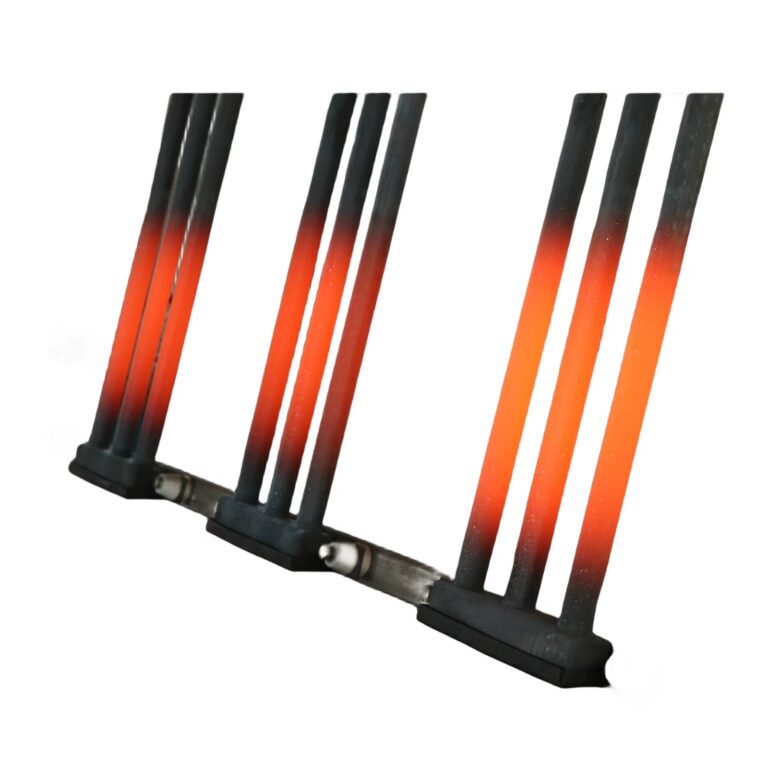
- Open coil elements. Bare NiCr 80/20 resistance wire supported on ceramic insulators. Fastest heat-up, highest maximum temperature (up to 1,200°F), lowest cost per watt. But no physical protection—the wire is exposed to the oven atmosphere. Any corrosive off-gassing attacks the coil directly. Best for: clean-air high-temperature ovens and furnaces where rapid thermal response matters more than element longevity.
- Finned tubular elements. A tubular heating element with aluminum or stainless steel fins that increase effective surface area by 3-5×. The fins improve heat transfer to moving air, allowing higher watt densities at lower sheath temperatures. Operating limit approximately 600°F with aluminum fins, higher with stainless steel fins. Best for: forced-air convection ovens, conveyor ovens, and curing ovens where air moves at 200+ ft/min across the element.
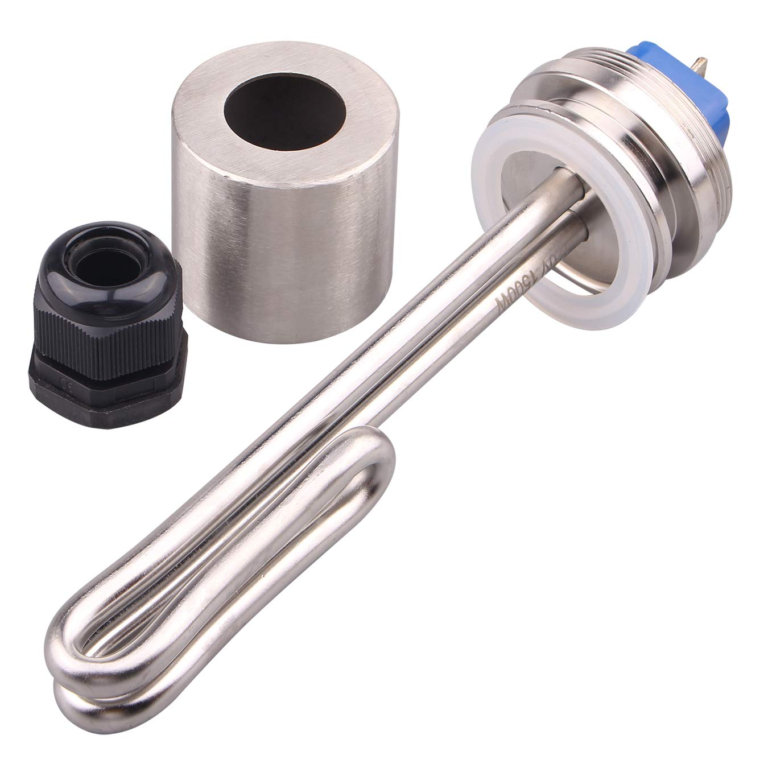
- Smooth tubular elements. A tubular element without fins, in 304SS, 316L, ou Incoloy 800 gaine. No fins means less surface area and lower watt density for a given temperature, but the smooth sheath resists corrosion far better than finned or open coil designs. Best for: ovens processing materials that off-gas acids, solvants, or moisture—environments where open coil and finned elements corrode within months (detailed open coil vs finned comparison).
For context on element fundamentals, voir notre aperçu de types d'éléments chauffants électriques standard.
Why Industrial Oven Heating Elements Fail—And How to Prevent It
Three failure mechanisms account for the vast majority of oven element replacements:
1. Watt density too high for the air velocity. An open coil element rated for 30 W/in² of wire surface works in forced air at 400 ft/min. In a dead zone—behind a baffle, in a corner, or in a natural convection oven—that same element overheats within weeks. The safe watt density drops as air velocity drops. If your oven has been modified (baffles moved, product carts reconfigured, fans downgraded), the original element specification may no longer be valid for the actual air flow pattern.
2. Sheath corrosion from process off-gassing. Curing coatings, drying adhesives, and heat-treating composites all release volatile compounds. Many of these are acidic. UN 304 stainless steel sheath—perfectly adequate in clean air—corrodes to failure in months when exposed to curing byproducts. An industrial oven heating element specified with a 316L or Incoloy 800 sheath costs perhaps 25% more and lasts 3-5× longer in these environments.
3. Mechanical damage from product contact. Oven racks and product carts shift over time. An element that had 3 inches of clearance when new may be 0.5 inches from a cart frame after years of use. Bent fins, crushed sheaths, or broken ceramic insulators create hot spots that cascade to burnout. Simple wire guards or heavier-gauge fins solve this at minimal cost.
How to Specify a Replacement Oven Heating Element That Outlasts the Original
When an OEM element fails, the instinct is to order the exact same part. Mais cette pièce vient de prouver qu'elle ne peut pas gérer vos conditions de fonctionnement.. Un remplacement correctement spécifié corrige la cause première:
- Confirmer la vitesse réelle de l'air à l'emplacement de l'élément. Pas la spécification de conception. Pas la note des fans. Mesurez-le avec un anémomètre à la position de l'élément dans des conditions normales de fonctionnement. Si la vitesse a chuté (filtres bouchés, usure de la courroie du ventilateur, modifications du déflecteur), réduire la densité de watts en conséquence.
- Améliorez le matériau de la gaine en cas de corrosion. Si l'élément défaillant présente des piqûres, décoloration, ou mise à l'échelle, le matériau de la gaine est incompatible avec l'atmosphère du four. Passez du 304SS au 316L. Si 316L montre également une attaque, aller à Incoloy 800. Le coût d’une gaine supérieure est insignifiant comparé aux temps d’arrêt dus à des pannes répétées.
- Faites correspondre les dimensions de montage exactes. Mesurer les centres des boulons, dimensions du support, et dégagement du boîtier de bornes. Un remplacement qui est “fermer” nécessite une modification sur le terrain qui crée des fuites d'air, points chauds, et les futurs points de défaillance.
- Ajouter une protection mécanique. Si l'élément défaillant montre des signes d'impact, spécifier une grille de protection ou une construction à ailettes renforcées. Ceux-ci ajoutent peut-être $15 au coût unitaire et éviter des milliers de temps d'arrêt.
Pour en savoir plus sur l'évaluation des fournisseurs d'éléments chauffants pour les commandes de remplacement, voir notre guide sur choisir les fabricants d'éléments chauffants industriels.
Lorsqu'un remplacement personnalisé est moins cher que l'OEM
Les éléments de remplacement OEM sont construits selon les spécifications d'origine, les mêmes spécifications qui ont produit un élément défaillant à chaque fois. 18 mois dans vos conditions réelles d'exploitation. Un remplacement personnalisé vous permet de corriger ce qui s'est mal passé avec l'OEM:
- Réduire la densité en watts pour correspondre à votre vitesse réelle de l'air, not the theoretical design velocity from 15 il y a des années. UN 20% reduction in watt density often doubles the element lifespan with a negligible impact on heat-up time.
- Upgrade the sheath material to handle the real chemical environment. The OEM specified 304SS because it was cheaper. Your process off-gasses acetic acid. You need 316L or Incoloy.
- Request a prototype first. A manufacturer that builds one element for fit-check and thermal validation before the full production run catches the dimensional error or watt density miscalculation before it becomes 12 wrong elements on your loading dock.
For a facility manager tracking maintenance costs, the math is straightforward. Ten OEM replacements at $280 each over five years, plus roughly 40 hours of downtime for changeouts: $2,800 in parts, plus thousands in lost production. Un ensemble de remplacements personnalisés correctement spécifiés à $450 chacun dure cinq ans: $450 in parts, zéro temps d'arrêt imprévu. L'option personnalisée gagne à chaque fois, si vous la spécifiez correctement.
Si vous avez besoin d'éléments chauffants pour fours industriels : serpentin ouvert, tubulaire à ailettes, ou gaine lisse – envoyez-nous l'élément défaillant ou ses spécifications. Avec 40+ années d'expérience dans la fabrication d'éléments chauffants et CE, UL, RoHS, CQC, et ISO 9001 production certifiée, nous construisons des remplacements conçus pour vos conditions de fonctionnement réelles.