Ko se električno vozilo sooči z okoljskimi pogoji pod ničlo, kemija litij-ionskih celic ima velik notranji upor, degraded discharge capacity, and severe lithium plating risks during charging. Fast, uniform heating is not an auxiliary luxury but a foundational requirement for battery life, vehicle range, and fast-charging throughput. to EV battery thermal management heaters guide provides automotive engineering and procurement teams with a practical evaluation framework covering heating architectures, flow dynamics, dielectric insulation, and supplier validation.

What Drives the Need for EV Battery Thermal Management Heaters?
Lithium-ion cells operate within a strict thermal window between 15°C and 35°C for optimal efficiency, longevity, and charge acceptance. Below 0°C, ionic conductivity in liquid electrolytes drops significantly, causing substantial power loss and preventing regenerative braking recovery.
Attempting high-power fast charging on a frozen battery pack without preheating risks permanent damage from metallic lithium deposition on the graphite anode. Modern EV platforms integrate dedicated EV battery thermal management heaters into their cooling circuits to elevate cell temperatures rapidly before charging initiates.
In our manufacturing and engineering practice, automotive OEM clients require heating systems that deliver high thermal response without localized hot spots. A well-designed heating solution prevents cell-to-cell temperature gradients from exceeding 3°C across the entire module assembly.
How Do Coolant Loop Heaters Compare to Direct Module Heating?
Automotive thermal systems primarily utilize two distinct heating strategies: indirect liquid coolant loop heaters and direct surface-mounted heating elements. Coolant loop systems circulate a heated water-glycol mixture through cold plates positioned beneath or between battery modules.
Liquid loop systems offer superior temperature uniformity and integrate seamlessly with existing multi-way valve circuits, cabin heat pumps, and power electronics cooling. Vendar, they introduce fluid resistance, pump energy consumption, and thermal mass delays during initial start-up sequences.
Direct heating elements, such as silicone rubber or polyimide foil heaters, apply heat directly to cell surfaces or module casing walls. While direct heating offers immediate localized heat transfer, scaling it across high-voltage large-capacity commercial packs increases wiring complexity and sensor count.
When selecting EV battery thermal management heaters, vehicle packaging, system voltage, and serviceability dictate whether an inline coolant heater or direct contact approach provides lower total life-cycle cost. Evaluating these trade-offs early in pack design prevents costly packaging revisions and ensures dependable thermal performance across extreme climate conditions.
Why Is Watt Density and Flow Velocity Critical in Battery Coolant Loops?
In an inline coolant heating assembly, fluid flow velocity across the element sheath directly dictates convective heat transfer efficiency. If the fluid circulation rate drops while heating power remains constant, localized fluid boiling and ethylene glycol degradation can occur rapidly.
Controlling surface watt density prevents thermal stress on heating element sheaths and ensures stable fluid film coefficients. In commercial vehicle battery loops operating at 400V to 800V architectures, maintaining sheath surface load within verified safe boundaries prevents premature element burnout.
Our engineering team performs rigorous flow modeling and boundary calculations for custom industrial heating systems. Applying verified calculations for EV battery thermal management heaters ensures that element surface temperatures stay well below glycol thermal breakdown thresholds during all operational modes.
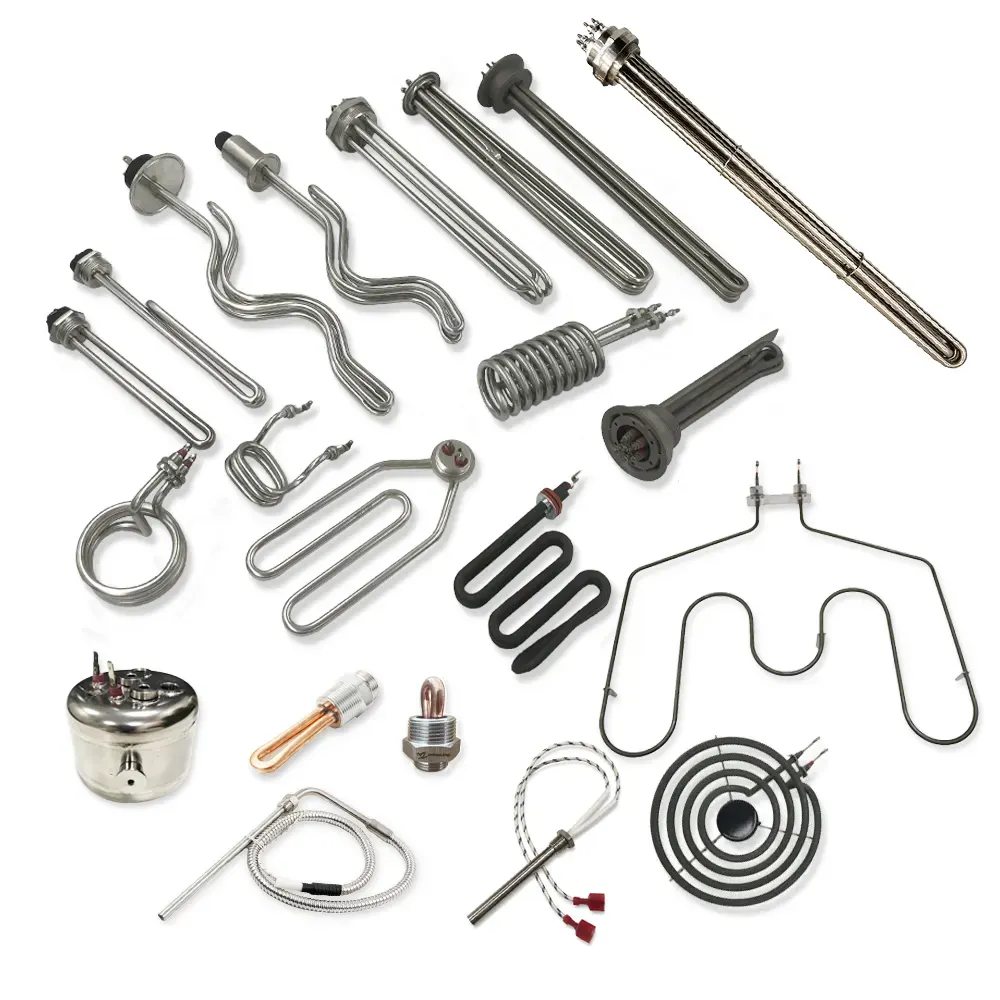
How Do Automotive Dielectric and Vibration Standards Affect Heater Reliability?
Electric vehicle operating environments subject electrical components to continuous dynamic mechanical vibration, thermal shock cycles, and humidity ingress. High-voltage battery systems demand robust dielectric insulation to prevent insulation breakdown between active resistance circuits and grounded vehicle chassis.
High-purity compacted magnesium oxide (MgO) insulation and precision-welded terminal seals are essential to maintain high insulation resistance over vehicle operating lifetimes. Terminal connections must endure ISO 16750-3 vibration profiles without micro-cracking, contact resistance drift, or moisture penetration.
At Vanorm, our 40+ years of electrical heating manufacturing expertise backed by ISO9001 and international quality certifications ensures robust product performance. Every heating element undergoes high-voltage withstand testing, leakage current verification, and hermetic seal validation prior to shipment.
How Do Different Heating Architectures Compare in Battery Packs?
| Evaluation Metric | High-Voltage Coolant Loop Heaters | Direct Surface Heating Mats | Integrated Heat Pump PTC Heaters |
|---|---|---|---|
| Thermal Uniformity | High across full pack via cold plates | Moderate, localized to element zones | High, shared with cabin HVAC circuit |
| System Packaging | Compact central unit in chassis loop | Distributed across all modules | Centralized, higher plumbing complexity |
| Cold-Start Speed | Moderate due to fluid circuit mass | Rapid direct conduction to cell walls | Fast, dependent on ambient air temp |
| Maintenance Access | External unit, easily serviceable | Internal to pack, non-serviceable | External cabin/chassis compartment |
| Voltage Compatibility | 400V to 800V high-voltage platforms | Usually 12V to 48V low-voltage sub-bus | 400V to 800V powertrain rail |
For official compliance and testing protocols regarding electric vehicle battery safety and thermal validation, review the regulatory frameworks from Rešitve UL. Compliance with international standards ensures that thermal components withstand severe operational and environmental stresses.
To explore related thermal calculations and manufacturing processes, pregled naše vodnik za izračun gostote vatov, our finned tubular heaters for HVAC guide, in naše custom OEM heating element manufacturing process. Understanding core thermal dynamics helps engineering teams specify optimal heating configurations.
Kontrolni seznam za revizijo dobavitelja: 5 Dokumenti, ki jih je treba zahtevati pred podpisom naročila
- Dielectric Withstand and Insulation Resistance Test Certificate: Verification of high-voltage dielectric isolation under high-temperature and damp-heat aging conditions.
- Thermal Shock and Vibration Test Report: Laboratory validation demonstrating compliance with automotive shock, random vibration, and cyclic thermal endurance profiles.
- Watt Density and Fluid Compatibility Analysis: Engineering data confirming sheath surface load limits, heat dissipation curves, and material resistance to ethylene glycol mixtures.
- Ingress Protection and Hermetic Seal Validation: Test evidence proving terminal enclosure sealing against moisture, salt spray, and atmospheric pressure changes.
- Automotive Quality Management Documentation: Production control plans, traceability records, and dimensional inspection reports confirming compliance with OEM engineering drawings.
Evaluating EV battery thermal management heaters requires technical scrutiny beyond catalog electrical ratings. Requesting verified test data ensures your battery pack thermal system delivers consistent preheating performance throughout severe winter operating conditions.
Pogosto zastavljena vprašanja
Q: Why is preheating necessary before DC fast charging in cold weather?
Charging lithium-ion cells at low temperatures causes rapid lithium plating on the negative electrode, leading to permanent capacity loss and internal short-circuit hazards. Preheating elevates cell temperatures into safe electrochemical windows where fast lithium-ion intercalation occurs without degradation.
Q: How do engineers prevent hot spots when using EV battery thermal management heaters?
Engineers combine optimized coolant flow channel routing with precise watt density control and closed-loop temperature sensing. At Vanorm, we engineer heating elements with uniform resistance distribution and balanced sheath geometry to ensure homogeneous thermal dissipation across circulating coolant streams.
Q: What voltage ranges are supported for custom automotive heating elements?
Custom heating solutions can be designed for 12V/24V/48V auxiliary systems as well as 400V, 600V, and 800V high-voltage traction battery architectures. Voltage ratings dictate dielectric insulation thickness, creepage distance requirements, and terminal connection geometry.
Q: What technical specifications should be provided for an OEM heating element inquiry?
Specify target operating voltage, required heating power in kilowatts, coolant flow rate, fluid composition, maximum allowable pressure drop, operating temperature envelope, and mechanical envelope constraints. This enables our engineering team to develop a fully optimized heating design.
For custom engineering support on EV battery thermal management heaters, share your system voltage, coolant flow rate, thermal envelope, and mechanical mounting specifications with our engineering team. We will review your application requirements to deliver an optimized heating solution for your platform.