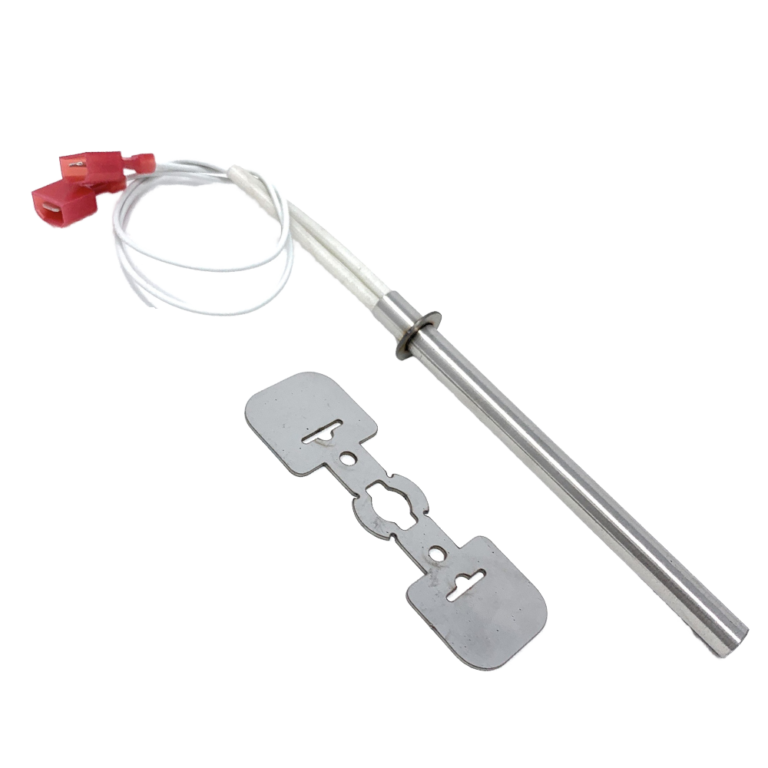

Industrial heaters run around the clock on tanks, fornos, dies and process lines. Most fail in slow motion: a degraded element increases resistance, the controller compensates, energy draw rises, and nobody notices until the line stops. IoT-enabled industrial heaters change that economics by turning every heater into a networked sensor — reporting temperature, resistência, current and runtime from the moment the unit is commissioned.
This guide explains what IoT actually adds to an industrial heater, which monitoring data matters, how predictive maintenance is built on it, and what to ask a supplier before specifying a connected heater package.
What “IoT” Means on a Heater, in Practice
A networked industrial heater adds three layers beyond a standard element:
1. Onboard sensing. PT100 or thermocouple at the heater surface, plus current/voltage measurement on the power line.
2. Edge gateway. A local controller that samples data, logs it and exposes it over Modbus TCP, Ethernet/IP, OPC-UA or 4G.
3. Cloud or SCFE dashboard. Trend views, alarms, runtime logs and alerts pushed to maintenance teams.
The heater itself is still a resistive element. The value is in knowing its condition continuously rather than during a planned shutdown.
The Data That Actually Drives Decisions
Not every sensor reading is worth wiring. The data points that change maintenance behavior are:
| Signal | What it reveals |
| Heater surface temperature | Overheating, scale build-up, failed thermowell |
| Resistance drift | Element degradation, impending open circuit |
| Current unbalance | Partial short, loose terminal, failing leg |
| Runtime hours | Scheduled replacement before failure |
| Power cycle count | Mechanical fatigue on terminals and welds |
| Process setpoint vs actual | Control loop drift, insulation loss |
| Corrente de fuga | Insulation breakdown, water ingress |
A heater that reports resistance drift 20 % above nameplate gives maintenance a weeks-long warning window instead of an unplanned outage.
Predictive Maintenance Built on Heater Data
Predictive maintenance for heaters follows a simple logic:
– Baseline. Record resistance, current and surface temperature at commissioning.
– Trend. Compare each new reading against baseline.
– Alarm. Trigger when resistance rises beyond a threshold (por exemplo. +15 %), when current unbalance exceeds a limit, or when surface temperature exceeds design.
– Schedule. Replace the element at the next planned stop, not at 3 a.m. on a Sunday.
For continuous process lines (reatores químicos, die casting, food extrusion), a single unplanned heater outage can cost more than the heater itself in lost production.
Where IoT Heaters Pay Back Fast
Highest-ROI applications:
– Continuous process lines where downtime is expensive.
– Remote or hazardous locations where manual inspection is difficult.
– Multi-site fleets where maintenance teams cannot visit every line weekly.
– Energy-heavy operations where heater efficiency can be trended and optimized.
Lower-value uses include small, cheap heaters that would cost more to monitor than to replace on failure.
Integration Reality Check
Before specifying IoT heaters, confirm what the system must talk to:

– Existing PLC / SCADA? Modbus TCP or OPC-UA usually suffices.
– Cloud dashboard? Confirm data ownership, hosting region and cost of the data plan.
– Cybersecurity? A connected heater is an attack surface; ask for firmware update policy, network segmentation support and authentication.
– Bandwidth and power? Local gateways usually need 24 VDC and a wired network; 4G versions exist but add per-unit data cost.
Common Pitfalls
– Sensor placement. A thermocouple on the wrong side of a baffle reads air temperature, not heater surface temperature.
– Alarm fatigue. Alerting on every minor fluctuation means no one reads real alarms. Set thresholds with the maintenance team.
– Data without action. A dashboard nobody opens is decoration. Assign an owner and a response procedure.
– Firmware abandonware. Ask the supplier how long firmware and cloud support continue after purchase.
Lista de verificação de auditoria de fornecedor
1. What onboard sensors are standard, and what is the upgrade cost for additional measurement points?
2. What protocols are supported (Modbus TCP, OPC-UA, Ethernet/IP, 4G)?
3. Is the cloud dashboard included, per-unit, or licensed separately?
4. Can alarms be routed to email, SMS or existing ticketing systems?
5. How is firmware updated, and what is the supported lifetime?
6. Can the system integrate with an existing SCADA or historian?
7. What is the typical ROI case the supplier has measured, and can they share a reference?
8. What happens to the heater if the network goes down — does it fail safe?
Perguntas frequentes
P: Do IoT heaters reduce energy use?
A: They do not automatically reduce energy, but they reveal heaters running below efficiency (escala, overshoot, cycling) that waste power. Optimization from that data typically recovers 5–15 % on monitored systems.
P: Is the heater itself different from a standard element?
A: The resistive element is the same; the difference is onboard sensors, a gateway and the data interface. Mechanical and thermal performance match the equivalent non-connected heater.
P: Can I retrofit IoT sensors onto existing heaters?
A: Some sensors (current, runtime) can be retrofitted at the power panel; surface temperature sensors usually require installation during heater replacement.
P: What network security is needed?
A: Treat the heater as an OT device: isolate it on a maintenance VLAN, require authentication, and plan for firmware updates. A reputable supplier will provide a network diagram.
Contate-nos
For IoT-enabled heaters on your process lines, send us your heater type, existing PLC/SCADA protocol, and number of units to monitor. We will return a package with onboard sensing, gateway options and integration notes. Reach us through the contact page or WhatsApp.