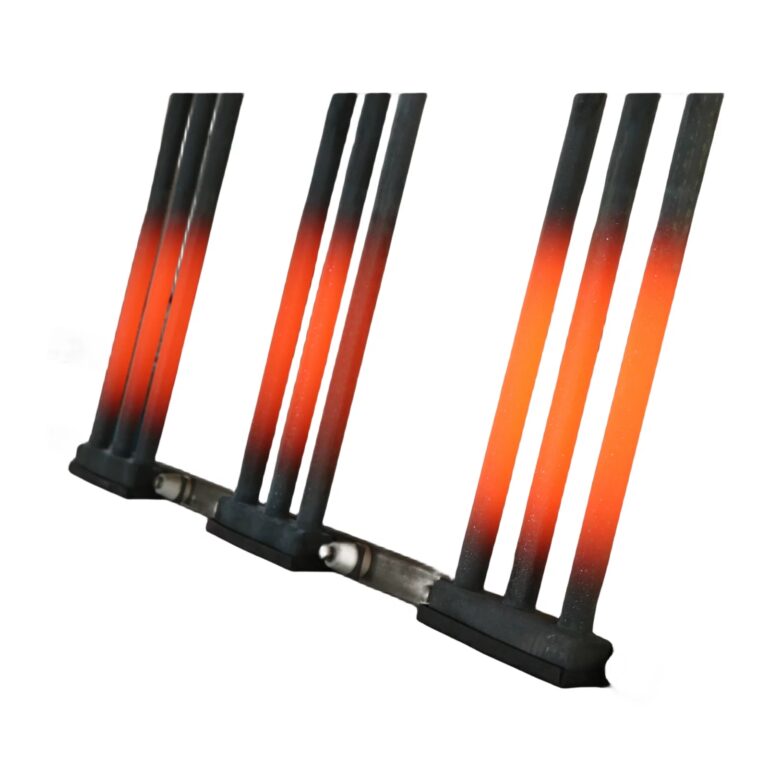
Your industrial oven has been running two shifts a day for four years. Now one heating zone is 15°F below setpoint, the temperature controller is compensating harder, and you know what that means—at least one industrial oven heating element is losing output. You open the spares cabinet. Empty. The last time you ordered these, lead time was six weeks.
Industrial oven heating elements operate in a hostile environment: sustained high temperature, thermal cycling, and—in many processes—corrosive off-gassing from the materials being cured or dried. When they fail, the cost is rarely the element itself. It is the batch of product ruined by uneven heating, the production hours lost, and the overtime to catch up. This guide covers how to select the right element type, why they fail, and how to specify a replacement that outlasts the original.
Open Coil vs. Finned Tubular vs. Smooth Tubular: Three Oven Heating Element Types
Industrial ovens use three distinct heating element configurations. Each serves a different temperature range, air flow pattern, and chemical environment:
- Open coil elements. Bare NiCr 80/20 resistance wire supported on ceramic insulators. Fastest heat-up, highest maximum temperature (up to 1,200°F), lowest cost per watt. But no physical protection—the wire is exposed to the oven atmosphere. Any corrosive off-gassing attacks the coil directly. Best for: clean-air high-temperature ovens and furnaces where rapid thermal response matters more than element longevity.
- Finned tubular elements. A tubular heating element with aluminum or stainless steel fins that increase effective surface area by 3-5×. The fins improve heat transfer to moving air, allowing higher watt densities at lower sheath temperatures. Operating limit approximately 600°F with aluminum fins, higher with stainless steel fins. Best for: forced-air convection ovens, conveyor ovens, and curing ovens where air moves at 200+ ft/min across the element.
- Smooth tubular elements. A tubular element without fins, in 304SS, 316L, vagy nem 800 sheath. No fins means less surface area and lower watt density for a given temperature, but the smooth sheath resists corrosion far better than finned or open coil designs. Best for: ovens processing materials that off-gas acids, solvents, or moisture—environments where open coil and finned elements corrode within months (detailed open coil vs finned comparison).
For context on element fundamentals, see our overview of standard electric heating element types.
Why Industrial Oven Heating Elements Fail—And How to Prevent It
Three failure mechanisms account for the vast majority of oven element replacements:
1. Watt density too high for the air velocity. An open coil element rated for 30 W/in² of wire surface works in forced air at 400 ft/min. In a dead zone—behind a baffle, in a corner, or in a natural convection oven—that same element overheats within weeks. The safe watt density drops as air velocity drops. If your oven has been modified (baffles moved, product carts reconfigured, fans downgraded), the original element specification may no longer be valid for the actual air flow pattern.
2. Sheath corrosion from process off-gassing. Curing coatings, drying adhesives, and heat-treating composites all release volatile compounds. Many of these are acidic. A 304 stainless steel sheath—perfectly adequate in clean air—corrodes to failure in months when exposed to curing byproducts. An industrial oven heating element specified with a 316L or Incoloy 800 sheath costs perhaps 25% more and lasts 3-5× longer in these environments.
3. Mechanical damage from product contact. Oven racks and product carts shift over time. An element that had 3 inches of clearance when new may be 0.5 inches from a cart frame after years of use. Bent fins, crushed sheaths, or broken ceramic insulators create hot spots that cascade to burnout. Simple wire guards or heavier-gauge fins solve this at minimal cost.
How to Specify a Replacement Oven Heating Element That Outlasts the Original
When an OEM element fails, the instinct is to order the exact same part. But that part just proved it cannot handle your operating conditions. A properly specified replacement fixes the root cause:
- Confirm the actual air velocity at the element location. Not the design specification. Not the fan rating. Measure it with an anemometer at the element position under normal operating conditions. If velocity has dropped (clogged filters, fan belt wear, baffle modifications), reduce the watt density accordingly.
- Upgrade the sheath material if corrosion is present. If the failed element shows pitting, discoloration, or scaling, the sheath material is incompatible with the oven atmosphere. Step up from 304SS to 316L. If 316L also shows attack, go to Incoloy 800. The cost of a superior sheath is trivial compared to the downtime from repeated failures.
- Match the exact mounting dimensions. Measure bolt centers, bracket dimensions, and terminal housing clearance. A replacement that is “close” requires field modification that creates air leaks, hot spots, and future failure points.
- Add mechanical protection. If the failed element shows signs of impact, specify a wire guard or reinforced fin construction. These add perhaps $15 to the unit cost and prevent thousands in downtime.
For more on evaluating heating element suppliers for replacement orders, see our guide on choosing industrial heating element manufacturers.
When a Custom Replacement Is Cheaper Than OEM
OEM replacement elements are built to the original specification—the same specification that produced an element failing every 18 months in your actual operating conditions. A custom replacement lets you fix what the OEM got wrong:
- Reduce the watt density to match your actual air velocity, not the theoretical design velocity from 15 years ago. A 20% reduction in watt density often doubles the element lifespan with a negligible impact on heat-up time.
- Upgrade the sheath material to handle the real chemical environment. The OEM specified 304SS because it was cheaper. Your process off-gasses acetic acid. You need 316L or Incoloy.
- Request a prototype first. A manufacturer that builds one element for fit-check and thermal validation before the full production run catches the dimensional error or watt density miscalculation before it becomes 12 wrong elements on your loading dock.
For a facility manager tracking maintenance costs, the math is straightforward. Ten OEM replacements at $280 each over five years, plus roughly 40 hours of downtime for changeouts: $2,800 in parts, plus thousands in lost production. One set of properly specified custom replacements at $450 each that lasts five years: $450 in parts, zero unscheduled downtime. The custom option wins every time—if you specify it correctly.
If you need industrial oven heating elements—open coil, finned tubular, or smooth sheath—send us the failed element or its specifications. With 40+ years of heating element manufacturing experience and CE, UL, RoHS, CQC, and ISO 9001 certified production, we build replacements designed for your actual operating conditions.