If a kiln element survives the first commissioning cycle but fails after repeated starts, the problem is often not the nominal power. The real decision is whether the element can tolerate the kiln atmosphere, thermal cycling, contamination, and maintenance plan. This ceramic vs metallic heating elements guide gives engineers a practical way to compare the two technologies before approving a high-temperature kiln design.

What Is the First Question to Ask When Comparing Kiln Elements?
Start with the process, not the element material. Record the target temperature, ramp rate, soak time, cooling rate, chamber size, load arrangement, atmosphere, and the number of thermal cycles per week. These conditions determine whether the main risk is oxidation, contamination, thermal shock, mechanical sag, or unstable electrical control.
Ceramic and metallic elements can both be valid choices, but they do not fail in the same way. A procurement team using a ceramic vs metallic heating elements comparison should look beyond purchase price because the wrong choice may be difficult to replace, incompatible with the atmosphere, or inefficient at the actual operating duty.
How Do Ceramic and Metallic Elements Transfer Heat?
Ceramic heating elements commonly radiate heat directly into the chamber and can be arranged around a load without a liquid or air stream. Metallic elements also radiate heat at high temperature, while their electrical resistance, geometry, and support method influence how evenly the heated zone is distributed.
For either technology, the element layout matters as much as the material. Check the distance to the load, the view factor between hot surfaces, the location of thermocouples, and the insulation boundary. A powerful element can still create cold spots when the chamber geometry is poorly matched.
Which Element Material Fits the Kiln Atmosphere?
Atmosphere is the decision point many generic comparisons skip. Oxygen, water vapor, reducing gases, carbon-bearing compounds, halogens, and volatile binders can change the surface chemistry of an element. The same material may perform differently in air, vacuum, inert gas, or a chemically active process.
Ask the supplier to review the gas composition, pressure, dew point if relevant, and any fumes released by the load. This information is essential when comparing ceramic vs metallic heating elements for debinding, sintering, firing, heat treatment, or another process because early and high-temperature stages can impose different risks.
Our team treats material selection as an application review rather than a catalogue decision. Vanorm’s product range includes tubular elements for ovens and machinery, custom immersion heaters, cartridge heaters, finned heaters, and specialty elements. The correct design depends on the process window and the service environment supplied by the OEM.
How Does Thermal Cycling Change the Choice?
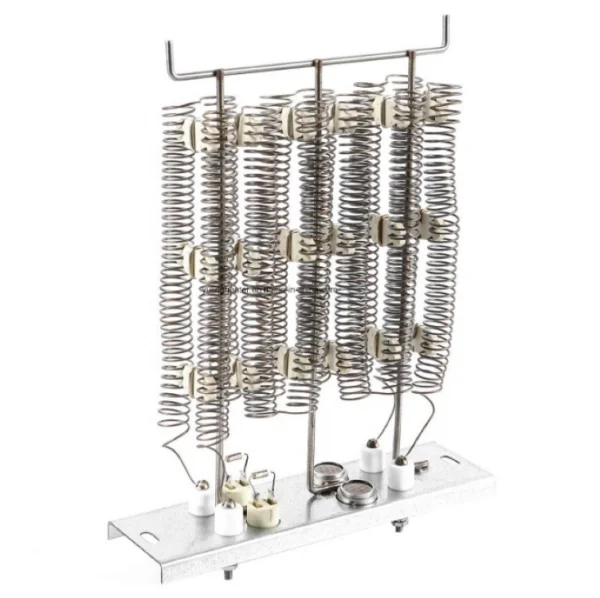
Repeated heating and cooling create expansion and contraction in the element, supports, terminals, and chamber structure. A ceramic element may be vulnerable to impact, uneven support, or rapid temperature changes, while a metallic element may experience creep, sagging, oxidation, or resistance drift over long service.
Define the complete cycle, not only the peak temperature. Record the cold start, ramp duration, soak period, controlled cool-down, emergency stop behavior, and restart interval. A design that works in a steady laboratory test may not survive an aggressive production schedule.
When we review an OEM layout, we also ask how the element is supported during transport and maintenance. A robust heating system can still be damaged by a loose support, a tool strike, or a replacement procedure that transfers load into a brittle hot component.
Which Option Is Easier to Maintain in Production?
Maintenance cost includes more than the replacement element. Add access time, cool-down time, chamber opening, spare inventory, technician skill, calibration checks, and the value of lost production. A less expensive element can become the higher-cost option if it requires frequent shutdowns or difficult alignment.
Metallic elements are often easier to inspect for visible deformation, oxidation, and terminal damage. Ceramic elements require careful handling and support inspection, so a ceramic vs metallic heating elements maintenance plan should define crack checks and spare-part protection before the kiln enters production.
Create a replacement drawing before the first order is released. It should show element geometry, active length, terminal orientation, support locations, clearances, electrical resistance, and the inspection points that a technician can verify without guessing.
How Should Buyers Compare Ceramic and Metallic Heating Elements?
| Decision factor | Ceramic element review | Metallic element review | RFQ evidence to request |
|---|---|---|---|
| Atmosphere | Check chemical compatibility and support stability | Check oxidation, corrosion, and resistance drift | Atmosphere statement and material recommendation |
| Thermal cycle | Check shock, handling, and support risk | Check creep, sag, fatigue, and ramp limits | Cycle profile and installation drawing |
| Heat distribution | Check radiation path and hot-zone layout | Check circuit grouping and active geometry | Chamber thermal map or layout assumptions |
| Maintenance | Check brittle-part handling and spare protection | Check replacement access and terminal inspection | Replacement procedure and spare-part drawing |
| Compliance | Check insulation, terminals, and assembly controls | Check electrical protection and material traceability | Test and certification scope for the assembly |
For electrical safety and certification questions, review the relevant product and service information from UL Solutions. This is a general safety reference, not a guarantee that either material is suitable for a specific kiln atmosphere or temperature cycle. The final approval must match the project specification.
For related engineering context, compare our watt density calculation guide, the industrial heating element manufacturer guide, and our custom OEM heating element process. These pages help connect material selection with geometry, surface load, and production control.
Supplier Audit Checklist: 5 Documents to Request Before Signing a Purchase Order
- Process atmosphere statement: List gas composition, pressure, moisture or dew point requirements, volatile load materials, and the supplier’s compatibility recommendation.
- Thermal-cycle worksheet: Show ramp, soak, cool-down, emergency stop, restart, and expected cycle count used for the design.
- Element and support drawing: Verify active length, terminal position, mounting, clearance, sag control, and replacement access.
- Electrical test record: Request resistance, insulation, earth continuity where applicable, circuit grouping, and control limits.
- Pre-shipment inspection sample: Confirm visual checks, dimensional inspection, labeling, packaging, and traceability for the delivered assembly.
A supplier who cannot explain the failure mode is not ready to recommend a material. Ask for the assumptions behind the ceramic vs metallic heating elements comparison, then check those assumptions against your actual load, atmosphere, cycle, and maintenance plan before signing the order. The same ceramic vs metallic heating elements review should also define who owns the replacement and inspection decision.
Frequently Asked Questions
Q: Are ceramic elements always better for high-temperature kilns?
No. Ceramic elements can suit some radiant high-temperature layouts, but the atmosphere, thermal shock, supports, control method, and maintenance procedure still decide whether the design is appropriate.
Q: When should a buyer consider metallic elements?
Consider metallic elements when the process, temperature range, atmosphere, geometry, and service plan are compatible with the selected alloy and circuit design. Request evidence for oxidation, creep, resistance stability, and replacement access.
Q: What information should I send for a kiln element quotation?
Send chamber dimensions, target and maximum temperature, atmosphere, ramp and soak profile, load material, available voltage, element layout, control method, and replacement constraints. This allows our OEM team to review the complete duty instead of guessing from wattage.
Q: Can I replace a ceramic element with a metallic element without redesigning the kiln?
Not safely in every case. The electrical resistance, terminal arrangement, radiation pattern, support system, clearance, and control response may change. Treat the substitution as an engineering review, not a direct part-number swap.
For a ceramic vs metallic heating elements review, send our team your chamber profile, atmosphere, thermal cycle, power supply, element layout, and maintenance constraints. We will review the application before recommending a custom heating solution.